

Overview
Mexico City (Spanish: México, Ciudad de México or CDMX) is the capital of the Mexican Republic, the most populous city in the country, and one of the most important financial and cultural centers of the American continent. The city center is built on the ruins of the Aztec capital Tenochtitlan, and later came to be the capital of New Spain, which included much of North America. The city grew fast in the 20th century, and today is North America's largest city (and the world's largest Spanish-speaking city) with 9.2 million inhabitants in the city proper, and 22 million in the urban area (in 2020).
Three of Mexico's many s are here: the colonial-era Centro Histórico, sites related to architect Luis Barragán in Chapultepec and the university campus in Coyoacán. Several more can be visited as a daytrip.
Districts
The city is administratively divided into 16 alcaldías (boroughs) which are in turn subdivided into colonias (neighborhoods), of which there are around 2150. However, it is better for visitors to think of the city in terms of districts, grouped by shared history and clusters of attractions. In addition to the most central districts, many older towns (like Coyoacán, San Angel and Tlalpan) merged into the urban sprawl while retaining some of their original and unique characteristics.
Other areas of Mexico City include: La Villa de Guadalupe - In the borough of Gustavo A. Madero in the northern part of the city. Home to the Basilica of Our Lady of Guadalupe, perhaps the holiest Catholic site in the Americas. Draws a large crowd of pilgrims from around the world every day. Magdalena Contreras - Sometimes called the city's "green lungs", this area in the southwest of Mexico City is heavily forested with eco-parks to the south and about 250,000 residents in the northern urban areas near the Periferico. This area lies west of Coyoacan. Iztapalapa - Largely impoverished area in the eastern part of the city that nevertheless has a number of historical and cultural sites and a famous Easter celebration Milpa Alta - Rural borough in the southeast of Mexico City. Famous for its mole production and festival, nopal cactus fields, and the San Andrés convent in Mixquic. Interlomas - Residential and shopping area at the West of the City Azcapotzalco - Mainly residential and industrial area in the northwest of the city. Home to the Parque Bicentenario, built in a former oil refinery, and the Arena Ciudad de México, a modern concert and sports venue. Tláhuac - A former island between the Lakes of Xochimilco and Chalco. Now famous for its production of pottery and an alternative embarkation point to see the ancient gardens and canals that used fill the Valley of Mexico. Iztacalco - Busy neighborhood in the heart of the city, it has a colorful colonial history with seven historic neighborhoods with cobblestone streets and quaint shops and restaurants, it is also the site of the Ciudad Deportivos, including the Autodromo Hermanos Rodriguez, where big auto-racing events are held as well as major music festivals
Understand
The greater Mexico City metropolitan area is one of the world's largest and the largest city in North America, with 22 million people living in the metropolitan area in 2020. It sits in the Valley of Mexico. It is shaped roughly like an oval of about 60 km by 40 km with large parts of it built on the dry bed of Lake Texcoco, and surrounded on three sides by tall mountains and volcanoes such as the Ajusco, the Popocatepetl and the Iztaccihuatl. Mexico City proper (with an estimated population of 9.2 million) is the country's capital, and since 2016 has been a "federal entity" with the same powers as the states of Mexico, though still separate from the states. Confusingly, the rest of the metropolitan area extends beyond Mexico City into the State of Mexico, which surrounds Mexico City on the west, north and east, and Hidalgo further north. Practically speaking, Mexico City refers to the city proper and is the area where tourists will spend all or most of their time.
The city center is above mean sea level, and some outlying areas reach up to . This is far higher than any metropolitan area in the United States or Europe, and some people have breathing difficulties because of this. If you live closer to sea level, you may experience difficulty breathing due to altitude and pollution. Air quality has, however, been improved in the last few years.
More than a third of the total Mexican economy is concentrated here. Most of the country's large and multinational corporations have headquarters in the city, mainly in the Polanco and Santa Fe districts.
The origins of Mexico City date back to 1325, when the Aztec capital city of Tenochtitlan was founded and later destroyed in 1521 by Spanish conqueror Hernan Cortes. The city served as the capital of the Vice-royalty of New Spain until the outbreak of the Independence War in 1810. The city became the capital of the Mexican Empire in 1821 and of the Mexican Republic in 1823 after the abdication of Agustin de Iturbide. During the Mexico-US war in 1847, the city was invaded by the American army. In 1864 the French invaded Mexico and the emperor Ferdinand Maximilian of Habsburg ruled the country from the Castillo de Chapultepec and ordered to build Avenue of the Empress (today's Paseo de la Reforma promenade).
Porfirio Díaz assumed power in 1876 and left an outstanding mark in the city with many European styled buildings such as the Palacio de Bellas Artes and the Palacio Postal. Diaz was overthrown in 1910 with the Mexican Revolution and this marked a radical change in the city's architecture. The 20th century saw the uncontrolled growth of the city beyond the Centro Historico with the influx of millions of migrants from the rest of the country. In 1968, the city was host to the Olympic Games, which saw the construction of the Azteca Stadium, the Palacio de los Deportes, the Olympic Stadium and other sports facilities. In 1985 the city suffered an 8.1 Magnitude earthquake. Between 10,000 and 40,000 people were killed. 412 buildings collapsed and another 3,124 buildings were seriously damaged in the city.
Mexico City has a monsoon-influenced temperate oceanic climate with five seasons, Spring, Summer, Monsoon, Autumn, and Winter. Spring months are mild and sunny, while the summer months warm and humid. The monsoon season lasts from June to September. Generally it consists of sunny mornings followed by cloudy afternoons with light to heavy rains. Dawn in the autumn and winter get really cold, but with an amazingly clear sky.
Temperatures range from 0°C in late October, November, December and January mornings, to 32°C in March, April and May during mid-day highs. Mornings and nights may be cold, bring a good jacket in winter to stay warm.
Many prospective travelers will be aware of Mexico City's somewhat dated notoriety for having terrible air pollution. The city sits in a valley surrounded by mountains and volcanoes, which results in poor air circulation and a tendency for air pollutants to stagnate over the city. Due to the extremely rapid pace of urbanization in the 20th century, little consideration was given to environmental planning. By 1987, air quality had deteriorated so much that one day thousands of birds appeared dead on the sidewalks of the city. Environmentalists attributed this to air pollution. This shocking event encouraged authorities to implement measures to improve air quality. Most heavy industries (glass, car and steel factories) and oil refineries were relocated outside of the city and unleaded vehicle fuels were introduced.
Today, the air quality is much better. Ozone and carbon dioxide levels are falling, and for most visitors, air pollution is no longer a major concern. For more detailed coverage of Mexico City's air pollution, see the Stay safe section. There still is a noticeable difference in air quality between the dry season (November to March) and the rainy season from June to September, with air quality being best during rainy season.
People With a population of more than 20 million in the greater metropolitan area, you can expect to find all kinds of people in Mexico City, in terms of racial, sexual, political, cultural and wealth diversity. Citizens are mostly Mestizo (people of mixed European and Amerindian racial background) and white. Amerindian people constitute less than one percent of the city's population, but there are some who are still moving to the city in search of opportunities. There are significant minorities of descendants of immigrants from Latin America, the Middle East and East Asia, as well as smaller ones from other regions. As elsewhere in Latin America, socioeconomic status tends to be highly correlated with ethnicity in Mexico City: by and large, the upper and middle classes have more European ancestry than the poor and the lower middle classes.
The city, like the rest of the country, has a very unequal distribution of wealth that can be characterized geographically, generally speaking, as follows: the middle and upper classes tend to live in the west and south of the city (concentrated in the delegaciones of Benito Juarez, Miguel Hidalgo, Coyoacan, Tlalpan, Cuajimalpa and Alvaro Obregon). The east of the city, most notably Iztapalapa (the most populous delegacion) is much poorer. The same applies to municipalities of greater Mexico City (Ciudad Nezahualcóyotl, Chalco, Chimalhuacán). Although there are pockets of poverty everywhere (and often side by side with the shiny-glitzy condos of the nouveau riche, like in Santa Fe in Cuajimalpa) and pockets of wealth in the East (such as Lomas Estrella in Iztapalapa), it is easily noticeable that as one travels east the buildings begin to look more shabby and the people look increasingly browner—a testimony to Mexico's heritage of racial and socioeconomic inequality.
Since it is a big city, it is the home of large foreign communities, like Cubans, Spaniards, Americans, Japanese, Chilean, Lebanese, and more recently Argentines and Koreans. Mexico City has a number of ethnic districts with restaurants and shops that cater to groups such as Chinese and Lebanese Mexicans, or gringos from the United States. It is the temporary home to many temporary migrants too, working here for the many multinational companies operating in Mexico while planning to return to their homeland, or trying to get their feet under them while moving on to somewhere more permanent. Foreigners of virtually any ethnic background may not get a second look if they dress conservatively and attempt to speak Spanish.
Mexico City is one of the most liberal cities in Latin America. Contrary to other Latin American capitals, it has a political orientation far to the left of the rest of the country. The centre-left PRD has governed the city continuously since its citizens were allowed to elect its mayor and representatives in 1997. It has liberal laws on abortion, prostitution, euthanasia and was the first jurisdiction in Latin America to legalize same-sex marriage (in December 2009). As such, this is generally a gay friendly city, particularly in the Zona Rosa District, and is generally friendly to foreigners and immigrants. See LGBT Mexico City
Although Mexico City is considered an expensive city by Mexican standards, your trip budget will depend on your lifestyle and way of traveling, as you can find cheap and expensive prices for almost everything. Public transportation is very cheap and there are many affordable places to eat. On the other hand, you can find world-class hotels and fancy restaurants with higher prices. For those with more expendable cash, you can find plenty of outlets for your dollars, euros, pounds, yen, etc.
Orientation Mexico City is divided up into 16 boroughs similar to those in New York, which in turn are divided into colonias (neighborhoods), of which there are about 2150. Knowing what colonia you're going to is essential to getting around, and almost all locals will know where the main colonias are (there are some colonias with duplicate or very similar names). As with many very large cities, the structure is relatively decentralized, with several parts of the city having their own miniature downtown areas. However, the real downtown areas are Centro, the old city center, and Zona Rosa, the new business and entertainment district.
The address system is fairly simple and has the street name, house number, colonia (neighborhood), borough, city, state and postal code. Many are confused by the fact that the house number comes after the street name, unlike in the US and many other countries where the number precedes the street. Sometimes addresses are instead given based on an intersection ("esquina de/con ..."), or on a street where a place is located and the two streets between which it is located ("... entre calles ... y ..."). It is good to point out that streets can frequently change names, long avenues are split into sections (such as Insurgentes into Insurgentes Norte, Centro and Sur), and street numbering is not always in order, especially in poorer neighbourhoods.
In Mexico City, streets within a neighbourhood often follow a certain theme, such as Latin American countries in the Centro Histórico, European cities in the Zona Rosa or intellectuals in Polanco. A typical address could be something like this: Colima 15, Colonia Roma Norte, Delegación Cuauhtémoc, México, Distrito Federal, 06760. Here, "México" refers to the city and not the country. The order is pretty standard except for the position of the postal code.
Photography For the avid photographer, there are a few pointers to keep in mind. The city is paranoid about cameras and especially about tripods. You might be asked to delete pictures, even if they were taking from a public space. You are not allowed to use a tripod in any ticketed place, such as museums, the metro stations, and architectural ruins. You will be politely asked to hold your camera in your hands. Apparently, it has something to do with being a professional, but it is non-negotiable.
Memory cards can easily be found at several locations, including at Radio Shack, Office Depot, Office Max, Best Buy or Wal-Mart. Prices tend to be on the high end, but they are still affordable. You could also try some of the places that are dedicated to selling photographic equipment, they are easily identifiable by the street signs for well known brand names. It is not unusual, however, for high-end camera retailers to offer few if any accessories.
For people who love to do street photography, a good place to start is in front of the Bellas Artes square, during afternoons. There is a smörgåsbord of faces cutting across the square and perching on one of the benches for an hour that will easily give you access to photography fodder. Many urchins and ethnic street dwellers have learned to ask for money before allowing you to shoot them. Sympathize and accept it as it is worth it.
Some museums, like the Museum of National History in the Chapultepec, charge an extra fee for those with video cameras. Also in most museums, flash photography is not permitted.
Language Spanish is Mexico’s official language, but at the majority of hotels and tour services the personnel also speak English. As the historic center of Aztec culture, there are still pockets of indigenous Nahuatl speakers. The Milpa Alta area is where you would most likely encounter people speaking the Nahuatl language.
Get in
Main article: Benito Juárez International Airport
Most travellers arrive to Mexico City by air, to Benito Juárez International Airport, located in the eastern part of the city. This is the most convenient airport to most parts of the Mexico City area. From the airport, downtown hotels can be as close as 15 minutes by taxi if traffic is light (which it rarely is). A bus terminal inside the airport makes for easy connections to nearby cities.
Mexico City's second airport is the main hub of Mexicana airlines and serves mostly domestic flights, with a smattering of regional destinations but no flights to the US. Opened 2022, it has modern luggage scanners which don't require passengers to remove laptops or liquids. Like most airports in Mexico, nobody actually uses the long official name of an obscure government figure, but rather, Chilangos simply call this airport "Santa Lucia", or often by the abbreviation "AIFA" (as opposed to "AICM", which denotes Benito Juarez/Mexico City International).
While constructing the new passenger facilities, workers uncovered several woolly mammoth remains, which are now housed in the beautiful new Museo Paleontologico Santa Lucia Quinametzen (inside the airport facility). If you have a spare hour or two between flights, a visit would be time well spent.
Flying to this airport could (maybe) save you some money over flying to MEX. Skyscanner and Google Flights don't include the Felipe Ángeles airport if you look for flights to/from Mexico City. Instead you need to specifically type in this airport. kiwi.com does include this airport when typing in Mexico City. When booking flights to Mexico City on other sites (such as Kayak), be aware that they sometimes show results that mix NLU and MEX arrivals and departures, so check your reservations before ordering an Uber to the wrong airport.
Ground transportation Like most outlying airports, NLU is not as convenient for travelers as MEX - allow at least 90 minutes from the airport to downtown.The airport is 49 km (30 miles) from the city and only limited public transportation is available.
The airport has its own train station called AIFA, which was completed in April 2026. It is served by Tren Suburbano trains. From the airport, trains go to the Buenavista station in Mexico City/Centro. At Buenavista station, you can transfer to Metro Line B (but remember, heavy baggage is not allowed on Metro trains).
Vivabus, will take you to the Central de Autobuses del Norte (North) and Central de Autobuses del Sur Terminal Taxqueña (South) bus terminals in the city. These buses are your fastest and easiest option, but their departures are not regularly timed so make sure you check the online timetables to make sure they suit your flight.
A bus station in the main terminal is served by ADO, Futura and Conexion buses. Buses from AIFA go to AICM (16 daily departures), Autobuses del Norte (4 daily departures), and the city of Pachuca (5 daily departures).
If you want to take regular public transport into Mexico City, it'll take you about 2 hours - although you could always book a ride share service at one of the stops along the way (luggage space on the buses is limited, and large luggage is forbidden on the Metro). Look for the Terminal de Pasajeros bus stop where the Mexibus will take you to Ojo de Agua (about 40 min), where you then have to change to another Mexibus for Ciudad Azteca (try to get an express, and do not get one that terminates at Central de Abastos). At Ciudad Azteca you can then change to the Metro (line B) - just follow the signs through the shopping mall and go over the bridge. The Mexibus requires a separate card for ticketing - the MI card for Metro and city buses won't work. The ticket machines are cash only and don't give change, although having 2 pesos leftover on your card if you only have 30 available isn't the end of the world.
The airport is relatively close to Teotihuacán (about 40 minutes' drive), so if you only have small luggage you could get a taxi (or Uber from Ojo de Agua) here and explore it on your way to the city.
This airport, known locally as Toluca International Airport, is in the city of Toluca 50 km southwest of Mexico City. There are very limited flights into Toluca. As of 2024, there are no international flights to Toluca. Domestic flights serve 8 destinations, including Tijuana, Monterrey, and Cancun.
Reaching the Toluca airport from the West of Mexico City (such as Santa Fe) is easy, but it can be time-consuming to do so from the rest of Mexico City.
Caminante offers the best transportation from and to Toluca's airport.
Viva Aerobus offers airport transport through its Viva Transfer shuttle on all flights to Toluca. Tren Insurgente is a new intercity rail system connecting Mexico City with Toluca and western Mexico State. As of 2026, the rail lines are complete and service operates to three stations in Mexico City, terminating at Observatorio where passengers can connect to inter-city bus lines or to the Mexico City Metro system.
Other airports MEX remains the best bet for most passengers to or from Mexico City. But NLU and TLC might work better for some travelers. Depending on your overall trip, it might also be worth considering flying to nearby cities as Puebla , Querétaro or Cuernavaca , but reaching Mexico City from these places could be quite time-consuming and tiresome.
By carpooling You can have a look for shared rides on Blablacar. These are around 30-50% cheaper than first-class intercity buses.
By bus See also Bus travel in Mexico.
Being the national transportation hub there are various bus lines going into and out of Mexico City in all directions, from/to around the country at varying distances. Regional bus companies serve the surrounding states of Mexico, Hidalgo, Puebla and Guerrero while nation-wide bus lines come from all over the nation to as far as the U.S border in the north and the Guatemalan border to the south. Most foreigners coming into the country would most likely fly in but it's also possible to travel to Mexico City by bus from various cities in the U.S. and from anywhere in the Central American isthmus.
The city has four major bus stations based on the compass points. They are:
Terminal de Autobuses de Pasajeros de Oriente (East). Serving destinations in the eastern & southeastern states of Veracruz, Puebla, Hidalgo, Oaxaca, Chiapas, Yucatan, Quintana Roo, Tlaxcala, Tamauliapas, Campeche, Tabasco and the Guatemalan border. Traffic in and around the TAPO area (and any other bus terminal for that matter) can get quite congested during peak/rush hours. Always give yourself an extra hour or so in travel time, including to/from, to be sure that you do not miss a bus or a connection.
There are many other smaller bus stations, which serve fewer destinations (mostly regional) but can be very useful if you wish to avoid congestion or are traveling to/from the outer parts of Mexico City. These include:
Aeropuerto (Mexico City Airport). There are two bus stations in terminals 1 and 2 of the Mexico City airport, serving nearby big cities such as Querétaro and Puebla. Buses to/from these stations are usually more expensive than those heading to the 4 main bus stations. Most buses stop at both stations.
Cárcel de Mujeres. Along the main road heading East from Mexico City, it serves buses heading to Puebla and points in-between.
Indios Verdes. Most buses to/from Pachuca stop here. Usually more convenient by public transport than the North Bus Station.
Caseta Chalco Coapa Ecatepec (Las Américas) Ixtapaluca Tlalnepantla
A list of long-distance bus companies is in the article Bus travel in Mexico.
By train Ferrocarril Suburbano The Ferrocarril Suburbano is a commuter rail system that connects downtown Mexico City with northern Mexico State municipalities. Service is provided on the Buenavista-Teotihuacan line (Blue), and the Buenavista-Cuauhtitlan line (Red). A third line (Green) connects Nezahualcyotl to Chalco. Communities served include Tultitlán, San Rafael, and Tlanepantla. Buses connect rail stations to nearby neighborhoods. When you run out of money on your card, use the machines at rail stations to add funds. Trains run from 05ː00 to midnight on weekdays (M-F), from 06ː00 to midnight on Saturdays, and from 07ː00 to midnight on Sundays and holidays. Trains depart as frequently as every 6 minutes during rush hour (hora pica) or as seldom as every 15 minutes on less popular routes on weekends.
A new railway line opened in 2026 connecting downtown Mexico City to the Felipe Angeles International Airport (AIFA) in the northeastern suburbs of Mexico State. Trains depart from the Buenavista Railway Station and operate daily from 05ː00 to 00ː30. Trains are clean, comfortable, modern and quiet.
El Insurgente is a new intercity passenger train between Toluca and Mexico City. The 57 km route includes four stations in Mexico State and three in Mexico City. The Metepec station in Toluca provides shuttle bus connections to the Toluca airport . Stations in Mexico City include Observatorio, Santa Fe, and Quiroga de Vasco. The Observatorio station is the terminus of El Insurgente. It offers connections to Metro Line 1 and Line 12, and the Terminal de Autobuses Poniente. The rail route includes a 4.6 km tunnel beneath the Sierra de las Cruces mountain. Quiroga de Vasco station connects to Cablebus route 3.
El Insurgente takes 45 minutes to travel between Toluca and Observatorio. Trains operate daily between 06:00 and 23:00.
Rail development Two new passenger rail lines are under construction: Tren Mexico-Pachuca - five stations in Mexico State and four in Hidalgo, The route begins at Buenaventura in Mexico City and ends in Pachuca. The train will include a station stop for Mexico City's AIFA airport (NLU). Construction began in early 2025 and it is expected to be operational in early 2027. Tren Mexico-Queretaro - 225 km rail line with three main stations: Buenaventura in downtown Mexico City, San Juan del Rio, and Querétaro, construction began in 2025 and the train is expected to be operational in the first quarter of 2029.
Get around
Mexico City is a huge place, but driving is definitely not a way to see it even if tourist attractions are scattered throughout the city. There are several public transport options. The city government operates the Metro and Metrobús bus rapid transit (BRT) system, which are cheap and reliable but can be very crowded during rush hour. It also operates a light rail line, RTP bus system and electric trolleybuses. There are plenty of franchised private buses, minibuses and vans, known as peseros and combis, which are less reliable and safe but reach more destinations. In the metropolitan area, there is a commuter train line and the Mexibús bus rapid transit system, but most destinations are only served by private minibuses and vans.
If you get lost and are far away from your hotel, hop into a pesero (mini bus) or bus that takes you to a Metro station (look for the sign with the stylized metro "M" in the front window). Using the wall maps, you can get back to a more familiar place (such as Zocalo or Bellas Artes). If it's after midnight, taking a taxi is your best bet.
The Sistema de Transporte Colectivo, known as the Metro, is one of the largest and most patronized subway systems in the world, with 12 lines that measure more than and carry 4.4 million people every day. The metro is relatively quick and efficient, especially as an alternative to taxis during rush hours when the streets are essentially parking lots.
Operating hours are from 05:00 to 00:00 on weekdays (starts at 06:00 on Saturday and 07:00 on Sunday). A last train leaves every terminal station at midnight. The metro trains run every couple of minutes, so if you just miss it, you won't have long to wait until another arrives.
It gets crowded, particularly lines 1, 2 and 3 and during the morning (07:00-09:00) and afternoon (17:00-19:00) rush hours: trains are often filled to significantly over capacity, and sometimes it will be hot and uncomfortable. It can get loud in the trains due to the noise of the wheels and due to conversation, vendors or people blasting their music.
The Metro is quite safe, but there are a few incidences of pickpocketing every day. Keep your belongings close to you; if you have bags, close them, keep them in sight and you won't have any problems.
Most of the network supports payment by contactless debit or credit card, though foreign cards may not be accepted. These smart cards can be used in all of the public transit network, with the exception of private buses. (As of March 2025, paper tickets are no longer available, and the ticket machines have been removed.) It is not uncommon for small groups to share the same card, passing through the turnstiles and tapping the card reader each time. You may still see families and people who may not have a card at the turnstiles asking passerbys to allow them to use their card, in exchange for cash.
Entire maps of the Metro system are posted around ticket booths and on platforms, but not always inside trains. Neighborhood maps around every station are also available near the ticket booths. Line 1 (pink) runs through many tourist hot spots, such as the Centro Histórico (Salto del Agua, Isabel la Católica and Pino Suárez), the Chapultepec Forest (Chapultepec), Condesa and Roma neighborhoods (Insurgentes and Sevilla) and the West (Observatorio) and East (San Lázaro) Bus Stations. Line 2 (blue) runs through the Centro Histórico (Allende, Zócalo and Bellas Artes) and reaches the South Bus Station (Tasqueña). Line 3 (green) runs near Coyoacán (Coyoacán and Miguel Ángel de Quevedo) and also near the University City (Copilco and Ciudad Universitaria). If traveling to and from the airport, you'll want to use Line 5 (yellow) to connect to the Mexico City International Airport (Terminal Aérea), and not Boulevard Puerto Aéreo of line 1, which is 1 km away but is still colloquially called "Aeropuerto". The North Bus station is also served by Line 5 at Autobuses del Norte. Line 6 (red) runs east–west through the north of the city and passes by the Basílica de Guadalupe (La Villa - Basílica). Line 7 (orange) runs through many touristic spots such as the Chapultepec Forest (Auditorio) and the Polanco neighborhood (Polanco). Line 8 (green) crosses the Centro Histórico north-south (Salto del Agua, San Juan de Letrán, Bellas Artes and Garibaldi). Line 9 (brown) runs near the Condesa neighborhood (Chilpancingo).
Using the metro Stations usually have food stalls inside and outside the entrances, and all have city-sponsored exhibits and artwork on display, so even if you don't have anywhere to go, the Metro is good for a look around and can be regarded as a tourist attraction in itself. If you missed the food stalls getting on the train, people selling all kinds of things are often available in the trains as well.
Although the Metro lacks informational signs in English, the system was designed with illiteracy in mind, so finding your way around should not be a problem. Lines are defined by number but also by a color, and that color runs as a thematic band across the entire station and along the entire route, so you always know what line you are on. Stations are identified by name but also by a pictorial icon that represents that area in some way. Some of the pictorial icons only make sense if you have some capacity with languages other than Spanish, such as the icon for Chapultepec being a grasshopper, since Chapultepec translates to Grasshopper Hill in Nahuatl.
Here are a few of the commonly-used Metro signs translated into English: Taquilla - Ticket booth Entrada - Entrance Salida - Exit No Pase - Do not enter. You'll still see many people passing through in order to walk less though. Andenes - Train platforms Correspondencia - Line transfer, marked with a "C" sign with the same outline as the metro station icons. Dirección - Direction you are heading inside a line: one of the two terminal stations.
Each platform has a large sign indicating towards which direction that train heads. For example, if you are travelling on Line 1 from Insurgentes to Pino Suárez stations, you are heading in the direction of the Pantitlán terminus ("Dirección Pantitlán"). On your return trip, you would be heading in the direction of the Observatorio terminus ("Dirección Observatorio").
As you enter a Metro station, look for the ticket booth. You may buy a smart card at the ticket booths, by asking for a tarjeta. There may be a minimum amount for your initial balance. You can ask for a recharge (recargar) at any ticket window to supplement your card's balance. If you don't speak Spanish, it might be easier to buy a card at the machines that can be found at a few major metro stations as well as at Metrobús and Tren Ligero stations, rather than in a Metro station ticket booth. Some machines only support recharging smart cards and do not sell them.
Once you have your card, go through the turnstiles. The stiles are clearly marked for exit or entry but if you are confused, follow the crowd. Put your card against the card reader above. Your remaining balance will be shown. Past the turnstiles, signs that tell you where to go depending on your direction within the line are usually clearly marked, as are signs that tell you where to transfer to a different line. There is no standard station layout, but they are all designed to facilitate vast amounts of human traffic, so following the crowd works well, as long as you double check the signs to make sure the crowd is taking you in the same direction.
On the platform, try to stand near the edge. During rush hours when it can get pretty crowded, there is sometimes a mad rush on and off the train. Although for the most part people are respectful and usually let departing passengers off first, train doors are always threatening to close and that means you need to be moderately aggressive if you don't want to get left behind. If you're traveling in a group, this could mean having to travel separately. At the ends of the platform, the train is usually less crowded, so you could wait there, but during rush hours some busier stations reserve those sections of platform exclusively for women and children for their safety. If this is the case, there will be a police officer blocking the way.
The trains are usually crowded places throughout the day. It's considered good manners to offer your seat to the aged, pregnant or disabled, as all cars have clearly marked handicap seats. In keeping with the mad rush on and off the train, people will move toward the exits before the train stops, so let them through and feel free to do the same when you need to (a con permiso helps, but body language speaks the loudest here). You may see people walking through the carriages announcing their wares for sale or performing for money. Act as if you are used to them (that is, ignore them, unless they need to pass you).
Women have complained of being groped on extremely crowded trains; this is not a problem on designated women's wagons, or any other time than rush hour. If theft or any other sort of harassment do occur, you can stop the train and attract the attention of the authorities by pulling on alarms near the doors, which are labeled señal de alarma.
When exiting, follow the crowd through signs marked Salida. Many stations have multiple exits to different streets (or different sides of streets, marked with a cardinal direction) and should have posted road maps that show the immediate area with icons for banks, restaurants, parks and so forth. Use these to orient yourself and figure out where you need to go. A good tip is to remember what side of the tracks you are on, these are marked on such maps with a straight line the color of the metro line you are traveling.
There are several kinds of buses. The fastest and nicest are the BRT (bus rapid transit) buses discussed in the next section, "Metrobus and Mexibus". Another good option for travelers are the full-sized buses operated by the Mexico City Government known as RTP and Ecobús. If there isn't a coin box, give the money to the driver. RTP buses are orange and green, while Ecobús buses are all green.
Another kind of buses are known as microbuses or peseros. These buses are privately run and come in small and bigger sizes. Newer peseros look like regular buses but are painted in white and purple, while older ones are ominous looking and painted in green and grey.
All buses are supposed to stop at bus stops, but microbuses are usually willing to stop anywhere as long as there are no police nearby. In the inner city, bus stops are usually small bus shelters with metal seats. In other areas, they might be unmarked and you can reasonably assume that a bus will stop just before a big intersection. Routes are also very complex and flexible, so be sure to ask someone, perhaps the driver, if the bus even goes to your destination ("va a ...?"), before getting on. Also, though the locals hang off the sides and out the doors, it is generally not recommended for novices. Riding BRT and RTP buses is safer and more comfortable than the private franchised and smaller microbuses, which are more prone to robbery and often drive aggressively. All buses display signs on their windshields which tell major stops they make, so if you want to take a bus to a metro station, you can just wait for a bus that has a sign with an M followed by the station name.
Buses can be packed during rush hours, and you have to pay attention to your stops (buses make very short stops if there's just one person getting off, so be ready), but they are very practical when your route aligns with a large avenue. There's usually a button above or close to the rear door to signal that you're getting off; if there isn't one, it's not working, or you can't get to it, shouting Bajan! (pronounced "BAH-han") in a loud and desperate voice usually works.
Moovit and Google Maps show you a way through the city. Both cover the buses and the metro trains. Moovit has more bus lines and bus stops covered.
The Metrobús is a Bus Rapid Transit (BRT) system that operates seven routes (líneas) in dedicated lanes along Insurgentes, Eje 4 Sur, Eje 1 Poniente (Cuauhtémoc/Vallejo), Eje 3 Oriente, Eje 5 Norte Avenues, and Ave Paseo de la Reforma. Line 1 is convenient for the Condesa/Roma area, Line 3 for Del Valle and the Centro Histórico and Line 4 has a route to/from the airport (with stops at terminals 1 and 2) that passes through the Centro Histórico. The Metrobús is safe but can be crowded.
These cards can be used at the Metro and Tren Ligero as well. Lines 1, 2, 3, 5 and 6 have enclosed stations with turnstiles where you pay. There are card vending machines at these stations. Lines 4 and 7 have regular bus stops and you pay when boarding the bus. Some stops have ticket machines but otherwise these can be bought/recharged at convenience stores along the route. If you are just arriving and want to take the Metrobús from the airport, you can buy the card at the 7-Eleven shops in both terminals.
The Metrobús has stops approximately every 500 m. Expect Line 1 to be crowded around the clock and other Lines to be crowded during rush hour, but it's a great way to move around very rapidly. There are branches in each route, buses that take multiple lines and buses that do not go all the way from terminal to terminal, so you must check the correct door to take the bus in your direction, as well as the bus' billboard before boarding to see which is the last stop they will visit. There are reserved boarding areas at the front of every bus (indicated on the platforms) for women, the handicapped and the elderly.
The Mexibús is a similar system covering areas of the State of Mexico (in the metropolitan area). The Mexibús is reasonably safe, but pickpocketing and robbery do sometimes occur.
Trolleybuses are operated by the Electric Transport Services. There are 15 trolley bus lines that spread around for more than 400 km. They usually do not get as crowded as regular buses, and they are quite comfortable and reliable. They have lower frequencies and can be a little slower than regular buses, since they are unable to change lanes as quickly. You pay in a coin box and bus drivers do not give out change. For tourists, the Eje Central line (Line A) is useful to go between the North and South bus stations or between these stations and the Centro Histórico.
The Tren Ligero consists of one single line that runs to Xochimilco, south of the city, from the Tasqueña Metro Station (Line 2, blue; often spelled as Taxqueña). For tourists, it is useful if you plan to visit Xochimilco, the Dolores Olmedo Museum, the Anahuacalli Museum, or the Azteca Stadium. You can use the same smart card as in the Metro and Metrobús, and new cards can be purchased at some stations along the line.
The cablecar system is not intended for tourists but can be a fun experience and a way to get a bird's eye view of some neighborhoods that are not friendly to outsiders. A popular route starts from the metro station Indio Verdes. The ride until the first stop goes along a street avenue for about 7 minutes. Then the cable car passes a highway. After the second stop it only goes through a rather poor neighborhood with grey houses far and wide. It's not recommended to leave the cable car stations and stroll around due to safety. If you have never taken a cablecar inside a city, here is your chance.
By ride hailing Uber, Cabify and Didi are available. The app Yaxi allows you to order a safe regular taxi to your location.
E-hailing services are surprisingly cheap in Mexico City, given the time they may take with the traffic. A 50-minute trip may end up only costing 300 pesos. So when planning your transportation, keep in mind that e-hailing may be more affordable in Mexico City than you're used to.
Also keep in mind that with the heavy traffic in Mexico City, it is very common to wait ~10 minutes for a driver to arrive, even if they are not very far from you.
Warning regarding e-hailing scams / issues There's a common e-hailing scam, where the driver does not pick you up and continues without you. This issue occurs in many other locations but is common in Mexico City. If you are paying by card, you should enable any security features in Uber or other apps to have a PIN that you must give to the driver when they pick you up.
If you are paying by card without a PIN, the driver may mark that they have picked you up, and continue without you. You cannot order another ride without first cancelling this ride, and Uber will not refund your money, but will tell you that in order to prevent situations like this, or where the driver picks up the wrong person by accident, you should have used a PIN.
This can be prevented by paying with cash, or by using the PIN feature when paying by card.
You may also notice that some rides where you're paying by cash, may be rejected by drivers who were looking to do this.
By taxi There are more than 250,000 registered cabs in the city and they are one of the most efficient ways to get around.
Although safety has substantially improved, catching cabs in the street may be dangerous. Taxi robberies, so-called "express kidnappings", where the victim is robbed and then taken on a trip to various ATMs to max out their credit cards, do sometimes occur.
The two most common recommendations for a safe cab riding experience are to make sure you take an official cab, and to notify a person you trust of the license plate number of the cab you are riding. Official taxis have a red box in the center lower area of their license plates that reads TAXI.
There are some additional precautions to minimize risk: Taxis have special license plates. The registration number starts with an "A", "B" or "M" followed by five digits. Base ("Sitio") taxis are safer. These plates are white and have a small green and red squares at the bottom corners. The taxi license should be displayed inside the taxi; usually it is mounted somewhere above the windshield. Check that the photo of the driver on the license is of the actual driver. Make a point of looking at it. Look for the meter. Without it, they will be more likely to rip you off. All taxis in Mexico city have meters. If you are nervous, take sitio taxis only. These may be a bit more expensive, but they are well worth the expense. Most restaurants, hotels, etc., have the number for radio taxis. Radio taxis charge more than regular taxis, but are available all night. Hotel taxis will be significantly more expensive than site or radio taxis. As with absolutely everything else, risks are greater at night. At night, radio taxis are recommended.
Mexico City is so large, and many street names so common that cab drivers are highly unlikely to know where to go when you give only a name or address of your destination. Always include either the name of the colonia or the district (i.e. "Zona Rosa"), as well as any nearby landmarks or cross streets. You will probably be asked to give directions throughout or at least near the tail end of the journey.
Unlike the United States and Canada, English is not widely spoken in Mexico, so if either your Spanish or your sense of direction is poor, carry a map and be prepared to point.
The Turibus is a sightseeing hop-in hop-off bus that is a good alternative to see the city if you don't have too much time. Your ticket is valid for all routes. Runs 365 days a year. Its main route includes the Zona Rosa, Chapultepec Park, Polanco, Condesa, Roma and the Historic Center. There are three secondary routes running South, West and North. The South route runs from Fuente de la Cibeles in Condesa to Coyoacan and Xochimilco. The West route (Circuito Polanco) runs between Polanco and Chapultepec. The North route (Circuito Basílica) goes to Tlatelolco and the Basilica de Guadalupe.
The new Capitalbus has a similar service. It has a central route that includes the Centro Histórico, Reforma and Polanco, as well as a route west to the Santa Fe business district, and a North route to the Basílica de Guadalupe and various churches. Buses have Wi-Fi.
By car Driving around by car is the least advised way to visit the city due to the complicated road structure, generally reckless drivers, and the 5 million vehicles moving around the city. Traffic jams are almost omnipresent on weekdays, and driving from one end of the city to the other could take you between 2 and 4 hours at peak times. Driving should be left to only the most adventurous and/or foolhardy.
Locals drive aggressively and traffic laws are complex and rarely followed. Bicycles and motorcycles tend to drive in the narrow spaces between cars, and on small streets children often run on the pavement as if they were in their backyard. Street names and road signs are not present everywhere, so driving can turn into a really challenging experience if you don't know precisely where are you going.
The condition of pavement in freeways such as Viaducto and Periférico is good, however in avenues, streets and roads varies from fair to poor since most streets have fissures, bumps and holes. Most are paved with asphalt and some used to be paved using concrete. Since the city grew without planned control, the street structure resembles a labyrinth in many areas. Berms and shoulders are missing along the sides of many roads and freeways such as Viaducto and Periferico; if you go off the side of the road, there will be a 20-30 cm drop-off.
A fast succession of white lines cutting the road perpendicularly means that a tope (large speed bump) is approaching and you should slow down immediately. Trolleys and the Metrobús often have exclusive lanes and the right of way when they don't. On streets with the Metrobús, left turns are not allowed. Some streets are blocked off behind gates and do not let drivers pass without stating their destination, converting them into small gated communities.
Street parking (Estacionamiento in Spanish) is scarce around the city and practically nonexistent in crowded areas. Some areas of the city such as Zona Rosa, Chapultepec, Colonia Roma and Colonia Condesa have parking meters on the sidewalks which are free on certain days and hours (depending on the location). It is possible to park in other streets without meters but is likely there will be a "parking vendor" (Franelero in Spanish) which are not authorized by the city, but will "take care of your car". Some of these fellows will "charge" you when you arrive, the best advice is to pay if you want to return to find your car undamaged.
Hoy No Circula ("today you do not drive") is an important anti-traffic and anti-pollution program that all visitors including foreigners must take into consideration when driving anywhere in Mexico City or Mexico State. The law applies to all vehicles, including those with foreign plates. It limits vehicle circulation to certain hours during the day or certain days depending on the previous days' pollution levels, how new your car is, the last digit of your plate number (plates with all letters are automatically assigned a digit) and whether the car has passed the bi-yearly emission controls. Newer and electric vehicles (which are usually the case for rentals) have a 00 or 0 hologram sticker and are exempted from most regulations. The "no circula" driving restrictions apply between 05:00 and 22:00.
If your plate begins with... 5 or 6 - you cannot drive on Mondays 7 or 8 - you cannot drive on Tuesdays 3 or 4 - you cannot drive on Wednesdays 1 or 2 - you cannot drive on Thursdays 9 or 0 - you cannot drive on Fridays
If you rent a car in Mexico City or Mexico State, check the window stickers. If you have a hologram of 0, the car is exempt from "no circula" restrictions. If you have a hologram of 1, the car can not drive on the first and third Saturday in addition to the days restricted by the license plate number. If you have a hologram of 2, the car can not drive on any Saturday in addition to the days restricted by the license plate number.
If the "Hoy No Circula" policies seem complicated, don't drive.
Avenues have preference over streets and streets over closed streets. Continuous right turns even when traffic light red are not allowed from 2016. Seat belts are mandatory for all seats. Police generally drive with their lights on, but if you're stopped by a police car, it is likely they will try to get money out you. It is up to you if you accept to give a bribe, but never offer one directly. Fines are usually cheap and can be paid at banks, supermarkets and convenience stores.
By bike See also Cycling in Mexico City.
Cycling in most parts of Mexico City is challenging, but central tourist areas are quite bike friendly. Travelers can use loaner bikes from the city's Ecobici stations and there are numerous dedicated cycle lanes along several main streets, including Reforma and around Chapultepec Park.
Recreational bike riding is encouraged by the city government, which closes off streets for the exclusive use of bikes at certain times, most notably, Sundays along Paseo de la Reforma. Other nice places to cycle include Chapultepec Park, which has many bike paths and shared use trails, and the cycling path installed on the former railway line to Cuernavaca, which passes through Polanco and Lomas and reaches all the way to the Morelos state limits. Bicycles can be taken in the Metro and Tren Ligero on Sundays and at other off-peak periods.
By foot Unfortunately, although public transport is frequent and reliable, taxis blanket the city, and Uber comes almost instantly, the traffic and crowds in the central neighborhoods (Chapultepec, Zona Rosa, Centro Historico) are so intense that at rush hour (most of the day) walking is about as fast as any of those options. The good news is that streets have sidewalks, the center is safe during the day, and you can be assured of finding something interesting on every block. The bad news is that this area is nearly 10 km across, so you may want to hop on a bus just to take the weight off your feet.
See
Downtown Mexico City has been an urban area since the foundation of Tenochtitlán in 1325, and the city is filled with historical buildings and landmarks from every epoch since then. It is also known as the City of Palaces, because of the large number of stately buildings, especially in the Centro. Mexico City has three World Heritage Sites: the Centro Histórico and Xochimilco, the house of architect Luis Barragán and the University City campus of UNAM. In addition, Mexico is one of the cities with the largest number of museums in the world.
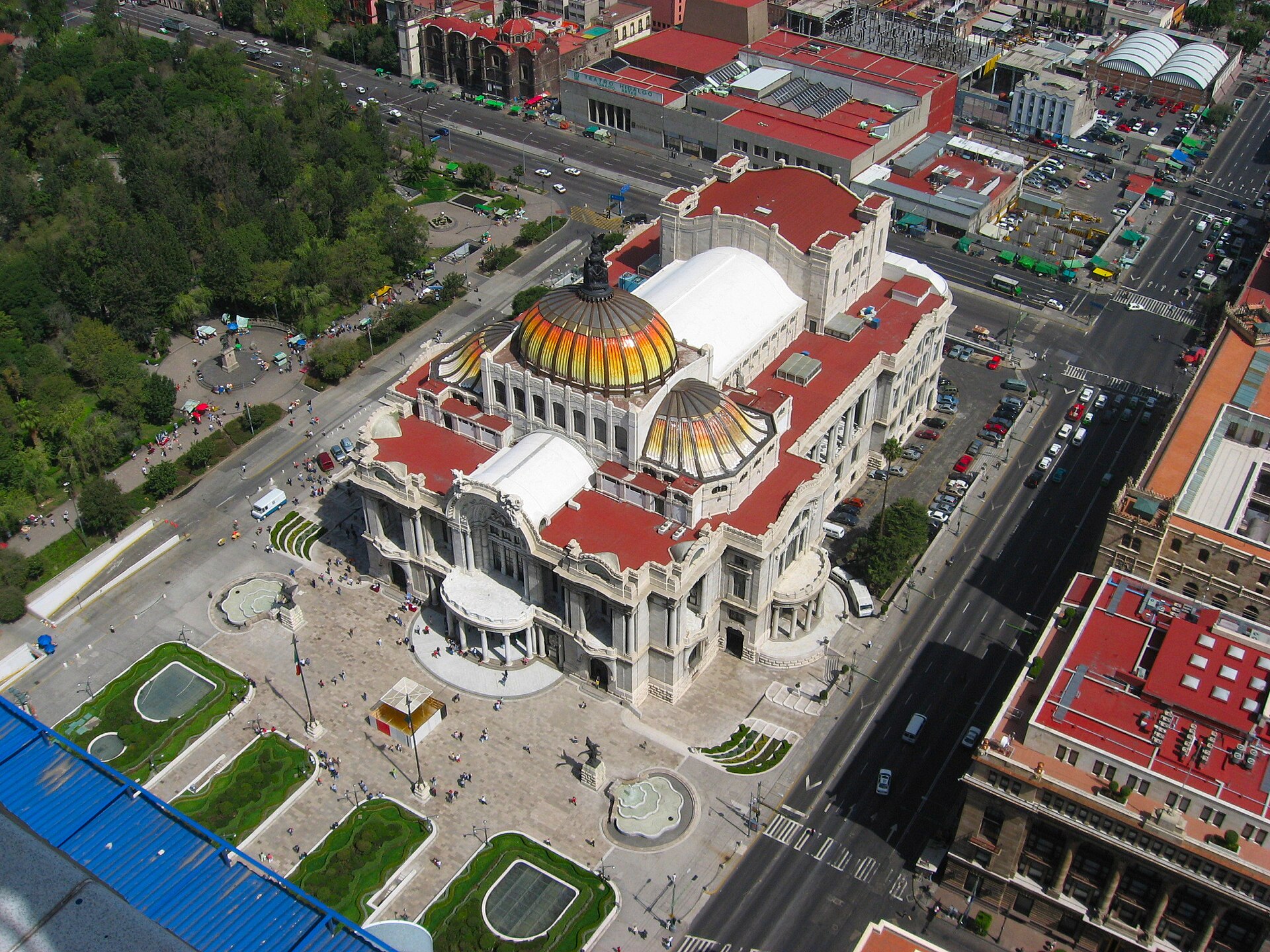
Plaza de la Bellas Artes. Commonly known as Palace of Fine Arts or Cathedral of Arts in Mexico, host of art events and art exhibitions, along with a number of enormous murals including Diego Rivera's El hombre controlador del universo and Jorge González Camarena's Liberación.
Plaza de la Constitución. Commonly known as Zócalo, it is one of the largest squares in the world, surrounded by historic buildings, including the City Hall and the Cathedral.
Catedral Metropolitana de la Ciudad de México. Next to El Zocalo in the city center. The biggest cathedral in the Americas. Containing many altars, its principal altar is made from solid gold.
Angel de la Independencia. A monument in Reforma Avenue that celebrates Mexico's independence in 1810.
Basílica de Guadalupe. Catholicism's holiest place in the Americas, and the destination of pilgrims from all over the world, especially during the yearly celebration on the 12th of December. It is the shrine that guards the poncho of Juan Diego that contains the image of Our Lady of Guadalupe, and is in the northernmost part of the city.
Ciudad Universitaria. The main campus of the Universidad Nacional Autónoma de México, the National Autonomous University of Mexico. Located on Insurgentes Sur Avenue, it is one of the world's largest universities, with more than 270,000 students every semester. In 2007 it was declared a .
Coyoacán. Historic Colonial Arts district which was home to Frida Kahlo, Leon Trotsky, and Diego Rivera, among others.
Plaza Garibaldi-Mariachi. The square is surrounded by cafés and restaurants much favored by tourists, and in these and in the square itself groups of musicians play folk music. Most of these groups are "mariachis" from Jalisco, dressed in Charro costume and playing trumpets, violins, guitars and the guitarrón or bass guitar.
Paseo de la Reforma. A 12 km long grand avenue built for the Emperor Maximilian's wife in the 19th century. Its name commemorates the liberal reforms of Mexican President Benito Juarez.
Cineteca Nacional. It was the first to screen art films, and is known for its forums, retrospectives and homages. It has four screening rooms, a video and a film library, as well as a cafeteria.
Torre Latinoamericana. For stunning views of the city. Its central location, height (183 m or 597 ft; 45 stories), and history make it one of Mexico City's most important landmarks.
Mexico City is full of various plazas and parks scattered through every neighborhood, but the following are some of the biggest, prettiest, most interesting, or best-known.
Alameda Central (Centro Historico) is the oldest urban park in Mexico City (1592) and the largest inside the Centro Histórico. Chapultepec Park (Chapultepec) is a large park in the middle of the city that hosts the city zoo, the Modern Art Museum, the Museum of Anthropology, the Children's Museum (Museo del Papalote), the Technology Museum, the Natural History Museum and the National Museum also known as Castillo de Chapultepec, the former residence of the Austrian Emperor Maximilian of Habsburg. Xochimilco (Xochimilco) is a vast system of waterways and flower gardens dating back to Aztec times in the south of the city where tourists can enjoy a trip in the "trajineras" (vividly-colored boats). Trajineras pass each other carrying Mariachi or marimba bands, and floating bars and taquerias. Xochimilco is the last remnant of how Mexico City looked when the Spanish arrived to Mexico City in 1521 and it was declared a world heritage site by UNESCO in 1987. A quieter alternative is to visit the Parque Ecológico Xochimilco, accessible by buses running along Periférico. Parque Mexico and Parque España (Condesa) are two adjacent parks that are popular for an evening stroll. They sometimes house outdoor exhibitions or concerts, and are surrounded by cool cafes and bars. Viveros de Coyoacán (Coyoacán) is a large expanse of greenery and trails that is still used as a nursery to grow trees for the city, but also a public park popular with joggers and amblers.
Museums Mexico City has more museums than any other city in the world. Note that most museums are closed on Mondays, and many are free to Mexican residents on Sundays, meaning larger crowds.
National Museum of Anthropology. One of the best museums worldwide over, it was built in late 1960s and designed by Pedro Ramírez Vázquez. Notice the huge, impressive fountain in the courtyard. It gathers the best collection of sculptures, jewels and handcrafts from ancient Mexican cultures, and could take many hours to see everything. They also have interesting international special exhibits.
Plaza de las Tres Culturas. Examples of modern, colonial, and pre-Columbian architecture, all around one square.
Museum of Modern Art. Here you will find paintings from Frida Kahlo, Leonora Carrington and Remedios Varo, as well as a sculpture garden.
Dolores Olmedo Museum. An art philanthropist left her former home, the grand Hacienda La Noria, as a museum featuring the works of her friend Diego Rivera. At least 137 of his works are displayed here, as are 25 paintings of Frida Kahlo. The premises also feature beautiful gardens full of peacocks and a weird species of Aztec dog. However, the museum is under renovation and is sched to reopen sometime in 2026.
Fine Arts Palace Museum. A concert hall and an arts center, it houses some of Mexico's finest murals and the Art Deco interior is worth seeing alone.
Museo Soumaya. A private museum and collection of many well-known European artists, including an extensive selection of works by Auguste Rodin.
Rufino Tamayo Museum. Contains the works of Mexican painter, Rufino Tamayo.
José Luis Cuevas Museum. Opened in 1992 and is filled with about 1,000 paintings, drawings, and sculptures from notorious artist, Jose Cuevas.
National History Museum in Chapultepec's Castle. The Museum's nineteen rooms contain, in addition to a collection of pre-Columbian material and reproductions of old manuscripts, a vast range of exhibits illustrating the history of Mexico since the Spanish conquest.
Papalote Children's Museum. If you've got kids, they'll love it! Bright, colorful, and filled with educational experiences for children of all ages.
Universum. A science museum maintained by UNAM, the largest university in Latin America. Take some time to wander around the Campus.
Casa Mural Diego Rivera. Contains murals of acclaimed artist, Diego Rivera.
National Palace (Zocalo). You can see some impressive Diego Rivera frescoes.
San Idelfonso Museum. There are some of Orozco's best frescoes. The temporary exhibitions are usually very good.
Franz Meyer Museum. Display the collections of Franz Mayer, it holds Mexico's largest decorative art collection and also hosts temporary exhibits in the fields of design and photography.
Mexico City's Museum. Great place to learn about Mexico City's eclectic history.
Templo Mayor Museum (Zocalo). Contains the ruins and last remnants of the Aztec empire. attached to the huge archeological site where the foundations of the temple were accidentally found in the 1970s.
San Carlos Museum. The San Carlos Museum holds some of Mexico's best paintings and exhibit 15th and 16th century paintings.
National Art Museum. The National Art Museum, houses a rich collection of Mexican art ranging from the 16th to the first half of the 20th centuries.
Frida Kahlo Museum. The former house of the painter since she was born to her death, and full of some of her works, and many of her personal artifacts.
Anahuacalli Museum. An impressive modern representation of Mayan architecture, it houses Diego Rivera’s collection of Aztec and other precolumbian cultures' sculptures.
Leon Trotsky Museum. This was the house where Trotsky lived in exile during the last 1.5 years of his life, and was murdered by one of Stalin's agents. Guided tours are provided by members of the Workers/ Revolutionary Party.
Architecture Mexico City has many stunning examples of architectural design, ranging from the country's oldest examples of colonial era architecture to the most cutting edge contemporary designs.
Some modern projects were designed by internationally famous architects, but many were also designed by architects trained and working in Mexico. Some of the most significant Mexican architects and iconic buildings in Mexico City that best represent their style are: Juan O'Gorman - see the Casa Estudio Diego Rivera y Frida Kahlo, and the Bibliotec Central de UNAM with its startlingly complex mosaic mural Luis Barragan - see the Casa Luis Barragan (a ), Casa Gilardi and the Torres de Satelite Mario Pani - see the distinctive needle-point pyramid of Torre Insignia Pedro Ramirez - see the Basilica of Our Lady of Guadalupe Fernando Romero - see the swoopy lines of the Museo Soumaya Alberto Kalach - see the Biblioteca Jose Vasconcelos with its gravity-defying "floating stacks"
The entire Centro Historico is a treasure trove of Mexico's oldest buildings, many dating to the early 1500s. Most fascinating to students of architecture are the Metropolitan Cathedral, Casa de Azulejos, and Iturbide's Palace.
Art deco architecture After the Mexican Revolution, a wave of optimism swept the country with a consequent building boom in Mexico City. Many new buildings were designed in the fashionable Art Deco architecture where entire neighborhoods that date from the 1920s to 1940s remain standing as models for future generations of architecture students. Art deco buildings are found throughout the city, but the Condesa and Roma neighborhoods are particularly noteworthy. Some of the best examples of Art Deco architecture include: Edificio Nacional - built in 1932 and designed by Manual Ortiz with distinctive ziggurat setbacks on the upper levels Museo de Artes Popular Palacio de Bellas Artes - the interior detailing is particularly emblematic of Art deco design Fronton Mexico - built in 1929 as an indoor venue for the sport of jai alai, the building was renovated in 2017, preserving its original art deco design
Many buildings of the late 20th and early 21st centuries exhibit forms and details that often seem to be very large sculptures of contemporary artists. This is particularly true of svelte lines of the swoopy shaped Museo Soumaya (designed by architects Fernando Romero), and the bristling pointed roofline of the Museo Jumex (designed by British architect, David Chipperfield). These and several other contemporary designs can be seen in the Polanco neighborhood. One of the most intriguing examples of modern architecture is the Biblioteca Vasconcelos whose interior features the innovative "floating stacks" that seem to defy gravity.
Mexico City was the World Design Capital in 2018, awarded by the International Council of Societies of Industrial Design (ICSID).
Do
As the world's 7th largest city, Mexico City offers something for everyone and for every budget. Attractions in Mexico City focus less on lazing on the beach (there are no beaches in Mexico City!) and more on exploring the culture and urban culture of Mexico.
Itineraries Traveling in Mexico City with children
Wise Men's day. Most Mexican kids receive toys from the Three Wise Men (Reyes Magos). This is a celebration that pays homage to the aforementioned Bible story. To celebrate it the family gather to eat the "Rosca de Reyes", a sort of bundt cake filled with plastic baby Jesus figures. Traditionally, people who get a figure in their slice of cake are expected to host a feast with tamales on Candelaria Day, February 2. The surroundings of the Alameda Central park are filled with costumed Reyes Magos on the days leading to January 6.
Art Week. Each year in February, the world of contemporary art focuses on Mexico City's Art Week when parties, celebrations, special gallery exhibitions and myriad galas take place throughout the city. The event takes place at the same time as two other major art events, ZsONA MACO, and Feria Material as well as numerous other events at galleries and museums throughout the city.
Independence Day "Yell". In the evening, the President of the country (or the city mayor) salutes the crowds from the presidential balcony in the National Palace in the Constitution Square (Zocalo) and shouts the famous "Viva Mexico". The Zocalo (and the rest of the city) is decorated with ornaments and lights. This is an incredible expression of Mexican patriotism combined with a party mood. Expect big crowds with a big revelery. If you want smaller crowds, the squares at the center of every borough usually host similar celebrations.
Independence Parade. In the morning, there is a military parade that runs across Paseo de la Reforma, turns right at Juarez Avenue which later becomes Madero Street and ends at the Zocalo. 15,000 to 30,000 soldiers of the Mexican Army, Navy and Air Force march through the streets displaying its equipment and weapons.
Alebrijes Parade. Alebrijes are brightly colored fanciful animal figures that are one of Mexico's most iconic pop art genres. Each year, enormous Alebrijes floats are created and a parade is held along Paseo de la Reforma and then on to the Zocalo. Pink polka-dotted pigs, Purple-winged dragons, orange dogs with spiked haircuts....these and more will march in the parade. After the parade, the giant Alebrijes will be placed in plazas and public spaces along Avenida Reforma for a 3-4 week period when the public can get up close to take their Instagram-ready selfies.
Day of the Dead. Mexico is one of the few countries in the world that celebrates this day (Dia de los Muertos), in which people go to the cemeteries to offer tribute to their departed ones, and decorate their graves with marigolds and bright colors. But this is not a sad celebration, on the contrary, people give family and friends candy treats in the shape of skulls and bones made of sugar and chocolate, as well as delicious bread called "Pan de Muerto". Don't miss a visit to a public market to find these delicacies, and watch out for the parades to and from the local cemeteries. In Mexico City, festivities include the lively Desfile de Día de Muertos (Day of the Dead Parade) which was inspired by the James Bond movie, Spectre. The parade includes people dressed as calaveras catrinas and huge colorful alebrije balloon as well as floats and marching bands. The parade route goes up Reforma and over to the Zocalo. In Xochimilco, there are Day of the Dead parties on the canals and the already colorful trajineras are decked out in marigolds, skeletons and wildly fanciful themes.
Six Flags Mexico. Largest amusement park in Latin America. The park is fitted with several million-dollar attractions, including Batman the Ride and not for the faint-hearted Medusa Roller Coaster.
Parque Aztlan. Small urban amusement park in the heart of Chapultepec Park. Park entry is free but rides are paid for individually. Includes a giant Ferris wheel with 40 cabins, a large steel roller coaster, a carousel, and swings.
Estadio Azteca. The largest stadium in Latin America is also the eighth biggest soccer stadium in the world. It's the home of El Tri, the Mexico men's national team, and also home to two of the country's most famous soccer top-tier professional clubs: Club América and Cruz Azul. It also serves as venue for concerts and for occasional NFL regular-season games outside the United States. The stadium is undergoing renovations as it prepares to host the opening games of the 2026 FIFA World Cup.
Estadio Olimpico de Ciudad Universitaria. Simply known as "Estadio de C.U." Located south of the city, this was the site of the 1968 Olympic opening ceremony. It is home to Club Universidad Nacional, more often known as Pumas, a soccer team operated by the National University (UNAM). The Pumas began as an amateur team of UNAM students, but are now a top-tier professional team in the Liga MX (though still owned and operated by the university). The stadium hosts several sports, mainly soccer and American football.
Estadio Alfredo Harp Helu. Modernistic baseball stadium built in 2019 for 20,000 cheering fans. It is home field for the Diablos de Mexico, a Mexican League professional team.
Autodromo Hermanos Rodriguez. Built in 1962, this 4.4 km track hosts Grand Prix Formula One and other motor racing such as NASCAR and A1-Grand Prix. The next Formula 1 races are 29 October to 1 November 2026.
Arena Ciudad de Mexico. With a full capacity of 22,300, Arena CDMX hosts indoor sporting events and a wide range of popular music events. It is the home for annual NBA basketball games played in Mexico, and also hosts home games of Capitanes de la Ciudad de México, the country's representative in the NBA G League.
Hipodromo de las Americas. Mexico City's home for horse racing, both thoroughbreds and quarter-horses. There are races nearly every day, with different zones for different budgets.
Lucha libre (loosely translated as "free fighting") is the term for the style of professional wrestling that developed in Mexico. Due to its affordable and entertaining nature, it is a favorite pastime throughout the country. While similar to professional wrestling elsewhere in that the outcomes are predetermined, it developed quite differently from wrestling in the rest of the world. Wrestlers, known in Mexico as luchadores (female: luchadoras), tend to work much faster than those in the rest of North America, employing complex chains of moves, numerous high-flying maneuvers, and often-realistic submission holds. Also, rings in Mexico often lack the spring supports used in many other countries, which means that wrestlers typically don't take falls landing on their back as they often do elsewhere. More often than not, aerial moves involve wrestlers launching themselves outside of the ring at their opponents, allowing them to break the fall by tumbling. Finally, Mexican wrestling has far more weight classes than in other countries.
Another hallmark of lucha libre is the emphasis on tag team matches, which are most often made up of three-wrestler teams instead of the pairs that are common elsewhere. Rules for tag team matches are also significantly different.
Perhaps the most distinctive feature of lucha libre is the colorful masks worn by many performers. While the concept of the wrestling mask was borrowed from the U.S., it has become infused with the role that masks have long played in Mexican culture. Almost all luchadores will begin their careers wearing them, but most will lose their masks at some point in their careers. The biggest matches in lucha libre are luchas de apuestas ("betting fights"), in which wrestlers will bet their masks, hair, or even their careers on the outcomes.
Arena México. The most famous venue for lucha libre.
Arena Coliseo. Another famous venue for lucha libre and boxing.
Concerts Many mexicans from around the country travel to Mexico City for concerts of national and international artists that don't perform in other parts of the country. The most prominent concert venues in the city are:
Estadio GNP Seguros. Previously known as Foro Sol. Palacio de los Deportes
Bellas Artes. Opera, traditional Mexican and classical music.
Circo Volador. Alternative music and metal.
Ollin Yoliztli. Home to the Mexico City Symphonic Orchestra.
Sala Nezahualcóyotl. Home to the UNAM Symphonic Orchestra
Learn
Like many other things in the country, Mexico City has the largest concentration of universities and colleges, starting with the UNAM, one of the finest in Latin America and the second oldest university in the American continent, founded in 1551.
Some of the most renowned universities in the city include: Instituto Politecnico Nacional Public university dedicated mainly to engineering and research. Universidad Nacional Autonoma de Mexico Commonly known as UNAM, located in the south of the city mainly in Ciudad Universitaria, is a public university with a student population of more than 300,000. Instituto Tecnologico de Estudios Superiores de Monterrey simply known as "Tec" is a branch of the famous private institute in Monterrey, having 3 campuses in the Greater Mexico City Area: one to the south in Tlalpan, one in the western financial district of Santa Fe and one to the north in the industrial corridor of Atizapán de Zaragoza-Tlalnepantla de Baz-Cuautitlán Izcalli. El Colegio de Mexico, or Colmex is an exclusive graduate and teaching institution in the social sciences and humanities with a student to faculty ratio of roughly one to one. It contains a library with over 600,000 volumes and Large-scale inter-library exchange agreements are maintained with domestic as well as foreign universities. More than 60% of library users are external to El Colegio. About twenty percent of full-time students come from countries other than Mexico, and the majority of its graduates continue to do their PhD's at institutions like Harvard, Stanford, or Oxford Universidad Panamericana Private catholic university that holds one of the best business schools in the world: IPADE located in the seventeenth century Hacienda de San Antonio Clavería. Universidad Anahuac Recognized Private catholic university, aims on humanism and leadership. Universidad Intercontinental Private catholic university of Guadalupe affiliation. Universidad Iberoamericana Private university of Jesuit origin. Instituto Tecnológico Autonomo de Mexico Private university. Universidad Autonoma Metropolitana Commonly known as UAM, a public university with four campuses citywide. Universidad Tecnológica de Mexico Private university. Universidad del Valle de Mexico Private, a branch of Laureate International Universities. Universidad de Las Américas The first private university in México Universidad La Salle Private catholic university.
You can learn Spanish in Mexico City as there are various schools offering courses for foreigners, for example:
Centro de Enseñanza de Lenguas Extranjeras Known as CELE, is a faculty of the National University (UNAM) and is probably the most renowned, located south of the city in Ciudad Universitaria. Center for International Education, La Salle (CIEL) Academia Hispano México, S.A. de C.V. CIB Centro de Idiomas Bravo Walk Spanish Spanish School in Mexico City - Speak Like a Mexican
Work
Mexico has very strict immigration laws. In order to work you should obtain a permit known as FM2 or FM3 which is very hard to get unless you're marrying a Mexican citizen or you are working for a multinational company. Most foreigners working without a permit perform jobs such as language teachers, waiters or salesmen. Others own a restaurant or shop. If you're working without a permit and an immigration officer finds out, it could mean a fine, deportation or spending some time in a detention facility of the National Immigration Institute.
Buy
Money These ATMs have low withdrawal fees and are widespread throughout the city: banamex / citibanamex Santander Banorte If there is none of them near you, check these ATMs with low fees: BanCoppel BanBajío Banco Azteca Banjercito
Users of Bank of America, Barclays, BNP Paribas, Deutsche Bank, Westpac and Scotiabank may withdraw money with no fees at any HSBC, Scotiabank, BanBajío, Inbursa, Banregio or Mifel ATM.
Polanco. Upscale shopping and dining district centered around Presidente Masaryk and Campos Eliseos streets. It also has several shopping malls.
Condesa. Trendy district full with alternative stores and boutiques.
Centro Historico. The city's oldest shopping district, you can find almost anything here. The old department stores are clustered around 20 de Noviembre St.
Shopping centers Mexico City is famous among Mexicans for its huge malls. American-style shopping malls appeared in Mexico City by the late 1960s and are now are spread all over the metropolitan area. You will find malls listed in the district articles.
Premium Outlets at Punta Norte. Northwest of Mexico City (State of Mexico) in the intersection of Periferico (Mexico Hwy #57) and the Chamapa La Venta highway, near Ciudad Satelite. You will need a taxi or a car to get there.
Las Plazas Outlet Lerma. Mexico- Toluca highway Km. 50 in the intersection with Calzada Cholula in the City of Lerma, near Toluca. You will need a car to get there.
Ciudadela Market. A crafts market where cultural groups from around Mexico distribute their crafts to other parts of the country and the world.
The National Fund for the Development of Arts and Crafts (Fonart), Avenida Patriotismo 691, in Mixcoac, Avenida Paseo de la Reforma No. 116 in Colonia Juárez and Avenida Juarez 89 in Centro.
Although street vendors can be found almost anywhere in Mexico City, the following are more "formal" flea markets selling handcrafts, furniture and antiques.
Bazar del Sábado. In San Angel. Every Saturday, artists show and sell their paintings in a beautiful, cobblestoned zone of the city. There are also stores where they sell handcrafts.
Mercado de Artesanias. In Coyoacan on Saturdays, featuring handicrafts from all over the country, and classes for kids.
Plaza del Angel. In Zona Rosa, Calle Londres (metro station Insurgentes). Mostly expensive antique shops, the famous Sunday collectibles market has nearly vanished.
Mercado de Alvaro Obregon. In Colonia Roma
Monumento a la Madre. In Zona Rosa. Sunday art market.
Tianguis Cultural del Chopo. The main flea market for the counterculture in Mexico City. Along Aldama Street between Sol and Luna. Metro Station Buenavista. Not to be missed for anyone who wore a lot of black in middle school.
Mercado de Antiguedades de Cuauhtemoc. Near Centro Historico (metro station Cuauhtemoc), every Saturday 9AM-5PM.
La Lagunilla and Tepito. Near Centro Historico (metro stations Lagunilla and Garibaldi). La Lagunilla has some of the best antiques, and is a maze of interesting thing, although it is a high crime area with 317 reported robberies in 2006. Tepito is more for pirated CDs, stolen things, and knock-offs. This area is huge and it's very easy to get lost. Shopkeepers are mostly friendly and will point you toward the nearest Metro station. For safety, visitors to this market should dress down, go with someone else, and arrive early in the day when it's less crowded. If you don't speak Spanish it's probably better to stay away. The collectibles market takes place every Sunday from 9AM, mainly along Paseo de la Reforma at intersection with Allende.
Groceries You may want to buy groceries and food at any of the hundreds of supermarkets. These are some of the most common:
Chedraui. Mexican owned supermarket, offers you a wide variety of groceries, beers and spirits, beauty and personal care items. They offer in store pickup or delivery. Some stores offer kosher section.
The high-end City Market, small Sumesa and large Mega supermarkets. Sumesa has several locations around the Roma and Condesa. Owned by Comercial Mexicana.
Soriana. If you're staying in the Centro Histórico, a useful central one is inside the Forum Buenavista shopping mall, reachable by Metro Station Buenavista. From Roma and Condesa, you can easily reach the one inside the Paruqe Delta shopping mall (Metro Centro Médico).
Walmart. Also owned by them are the high-end Superama and discount-store Bodega Aurrerá supermarkets. Several throughout the city, including one near the airport. Stock just about everything, much like the supercenters found in the US. An easily accessible one is right next to the Nativitas Metro station (Line 2) on the west side of the Calzada de Tlalpan. Exit the Metro on the west side (toward Calle Lago Pte.) and make a left as you exit the station. The first thing on your left, just next to the station building, is the ramp going up to the Wal-Mart entrance. Visible from the train, impossible to miss.
For hard-to-find ingredients, such as vegetables and spices that are unusual in Mexico, try the Mercado de San Juan (Centro Historico). You can even find exotic meats here, such as iguana, alligator, ostrich, and foie gras.
Asian Pequeño Seúl ("Little Seoul") is a Koreatown in Zona Rosa.
Super Kise. South of the city, they sell Korean, Chinese and Japanese groceries.
Mikasa. Lots of Japanese food ingredients, candy and drinks
Kokeshi. Mostly Japanese food stuff but they also sell other Asian foods. They also sell Japanese dinnerware.
Kosher Many food products in Mexico including milk are kosher compliant. If you're looking for specific products, try some stores in the Polanco neighborhood. At some Chedraui branches you will find kosher departments, especially the ones in Polanco, Tecamachalco, Santa Fe and Interlomas neighborhoods.
Eat
You can find almost any kind of food in this city. There are regional specialties from all over Mexico as well as international cuisine, including Japanese, Chinese, French, Polish, Italian, Argentinean, Belgian, Irish, you name it. The main restaurant areas are in Polanco, Condesa, Centro, Zona Rosa, along Avenida Insurgentes from Viaducto to Copilco and more recently Santa Fe.
There are several Mexican chain family restaurants that can be assumed to be safe and similar no matter where you are, including Vips, Toks, La Casa de Toño and the more traditional Sanborns, all reminiscent of Denny's in the United States. They are uniformly good (if never excellent) and relatively approachable to those who have trepidation around Mexican cuisine. El Globo, a French-style bakery, has locations throughout the city selling both French and traditional Mexican pastries, like orejas (little ears), éclairs, empanadas, and rosca during New Year's. It can't be beat for a quick snack or bagful of pastries to eat later.
If you're on a budget, you can also try one of the myriad comida corrida (set menu) restaurants, frequented by many office workers.
Perhaps the most ubiquitous type of food almost anywhere in Mexico city are fast food outlets, located on the ground floor of a street-facing building, or puestos, street stands located on a sidewalk or almost anywhere there is room. Most of these serve the usual tacos or tortas, and they can be very cheap. Hygiene varies from good to abysmal, so eat at a place that has plenty of people. Given that most of these establishments cook entirely in view, you can tell if it's going to be okay or not. Often, a street taco stand is going to have better food than a sit down restaurant.
If you want to stuff your face with lots of real Mexican food at cheap prices then head over to a market, such as Mercado La Merced, the former central market in Centro Historico. There are several restaurants as well as stands serving up some delicious food. Huaraches and alambres are popular here. Another superb market in Centro is Mercado San Juan Arcos de Belem, full of food stalls offering all the Mexican favorites.
Vegetarian (vegetariano) alternatives are commonly available at larger restaurants, but don't expect much from street vendors. The magic phrases, for vegetarians or vegans, are "sin pollo" (no chicken), "sin carne" (no meat), "sin huevo" (no eggs) and "sin queso" (no cheese). If you can communicate this and then gesticulate to the menu, the waiter normally will give you suggestions. In regular restaurants, they will even try to edit an existing dish for you. Just make sure you are clear. Chiles Rellenos are usually filled with meat, but different fillings are a definite standard in any vegetarian restaurant.
There is a vegan scene scattered across the trendier neighborhoods. Much of it is world cuisine, but some of Mexico's famous meat preparations translate well to mushrooms and plant-based proteins, and indigenous traditions have known how to put beans and vegetables at the forefront of a meal long before the Spaniards introduced domesticated livestock.
Mexico City is deep into the part of the country that prefers corn tortillas to wheat flour tortillas. Don't expect to come across a big overstuffed burrito. In fact, here they call a flour tortilla filled with gooey cheese a gringa, also the slang term for "foreigner"! More generally, if you're only familiar with the Tex-Mex style of Mexican food exported globally by way of the U.S. border states, then there are a few surprises in store for you.
Most famously, Mexico City is the world capital of tacos. There are many other foods around the world that have taken the name "taco"; here they are always a small corn tortilla topped with seasoned meat and maybe a few garnishes like chopped onion, cilantro and a wedge of lime. Tacos al pastor – marinated pork derived from Lebanese shawarma. Look for the massive stacks of meat spinning on vertical roasting spits. Tacos de tripa – tripe (beef intestines) Tacos de suadero – thin slices of fried beef Tacos de barbacoa – tender, slow-cooked beef. It's rooted in the same roasting techniques that lead to barbecue in the southern U.S. Tacos de canasta – filled with various stews and bathed in oil, often made in the morning and kept warm in distinctive baskets
You will see plenty of other street foods: Cecina Adobada Quesadillas Tortas – sandwiches on a soft white roll, with choices of meat, cheese, sliced avocado and refried beans Huaraches – giant tortillas covered with different toppings/fillings Sopes Tamales – steamed corn dough with chicken or pork, accompanied by a cup of atole (hot chocolate corn starch drink), is the breakfast of the humble on their way to work. They are often in the form of tortas de tamal.
These dishes are mainstays on traditional menus. They may be prepared quite differently from the internationalized dishes you've seen closer to home: Enchiladas – rolled corn tortillas filled with meat or cheese and covered with salsa Enchiladas Suizas – "Swiss" style, covered with cream or cheese sauce Enchiladas de mole – covered with a savory chili-chocolate sauce Enfrijoladas – covered with a black bean sauce Pozole – hominy (corn) and meat stew. Pork is most traditional but chicken is fairly common. Chopped cabbage, chopped onions, radishes, fresh cilantro, and lime wedges are all also popular garnishes. Chilaquiles – fried strips of corn tortillas covered in salsa and other toppings such as eggs and cheese, often served for breakfast. It's a classic peasant dish, often seen as a use for tortillas that are in danger of going stale, but it's widely loved. Huevos Rancheros – eggs poached in a spicy tomato sauce, often served for breakfast. Alambres – grilled meat topped with chopped bacon, bell peppers, onions, cheese and salsa. It's the local dish that most resembles Tex-Mex fajitas. Arrachera Migas Pambazos
International cuisine If you want something more familiar, most American fast food chains have franchises here. You'll see McDonald's, Burger King, KFC, Pizza Hut, Papa John's Pizza, Domino's Pizza, TGI Friday's, Chili's, Dairy Queen, Subway, and yes, Starbucks. These are all fairly affordable.
Asian food restaurants are abundant, and the quality is good, and caters from cheap Chinese cafeterias to expensive and very good Japanese food. Korean, Japanese and Chinese are most common cuisines in Mexico City, while Indian, Thai and Indonesian can be harder to find.
Etiquette Tips (propina) are expected, with 10% the standard for decent service at all sit-down restaurants. You can tip more for very good service (15%), or tip less or not at all for poor service. In some establishments the tip is included in the final bill, so it is recommended to review every ticket carefully. It is also customary to tip the waiters, valets, gas dispensers, bellboys and other service providers. Leaving no tip at all is frowned upon.
In Mexico, there is no difference in prices if you sit inside or outside, it is the same if you eat at the bar or sit at a table.
Drink
Mexico City's nightlife is like all other aspects of the city; it is huge. There is an enormous selection of venues: clubs, bars, restaurants, cafes, and variations and combinations thereof to choose from. There is incredible variation, from ultramodern lounges in Santa Fe and Reforma, to centuries-old dance halls in Centro and Roma. There are also pubs in Tlalpan and Coyoacán and clubs of every stripe in Insurgentes, Polanco, Condesa and the Zona Rosa.
Traveling by yourself at night in certain areas of Mexico City is not a good idea, especially in Plaza Garibaldi, where pickpocketers are ever ready to relieve you of your unguarded cash. One of the ways you can check out the night life safely is by doing a Night Club Tour. These tours will typically take you to a few clubs and include transportation. Mexicans are for the most part very friendly and enjoy socializing.
The typical Mexican place to go to drink is the cantina, a bar where food is usually free, and you pay for drinks (exact policies and minimums vary). Cantinas serve a wide range of Mexican and foreign drinks, with prices usually reasonable compared to prices in the US, and you'll be continually served various Mexican foods, such as tacos (you should ask for 'Botana'). If your tolerance for Mexican music (mariachi or otherwise) and lots of noise is low however, this may not be your kind of place. Cantinas are open moderately late, usually past midnight at the very least. However some cantinas, like La Victoria, near the Plaza Garibaldi, are also open at midday for lunch.
A lower-end traditional option is going to a pulquería, where you can drink pulque, a fermented agave drink that was once sacred to the Aztecs. After being on a steep decline for decades, many are finding a new surge in popularity with young people, and pulque can now be found at hipster bars from time to time. They can be found in the Centro Histórico and around Xochimilco. If you don't like pulque, they usually serve beer as well.
Many bars play a combination of Spanish and English-language rock, electronic music, and some Latin/Caribbean music. These bars tend to close around 3-4AM.
Club music mainly falls into three main categories, pop, rock and electronic music. The pop places generally play what's on the music charts, Latin pop, and sometimes traditional Mexican music, and are frequented by a younger (sometimes very young) audience, and are often more upper class. The rock places play rock in the wide sense, in English and Spanish. Most people are at least over 18 in these places. The electronica clubs, which attract everyone from Mexico City's large subculture of ravers and electronica fans, of all ages. Most clubs close late, 3-4AM at the earliest, and some are open until 7AM or 8AM.
The best bet used to be the Zona Rosa, which has a large number of street bars with rock bands playing and a large selection of clubs, especially strip clubs and gay bars. South of Zona Rosa you can find the Condesa and Roma areas, with many options of bars and restaurants. Another good area is Polanco, particularly a street called Mazaryk, where you'll find plenty of good clubs but it is best to make a reservation. Republica, La Santa or Guilt (gay club) are posh and exclusive clubs on that street. Be forewarned - entrance is judged on appearance and to get a table a minimum 2-bottle service is required, unless it's a slow night [min. In addition, getting in could very difficult, as these are the most exclusive in town. There are also exclusive gay clubs in that area with the same characteristics: Envy night club on Palmas 500 and Made nightclub on Chapultepec next to the lake and the restaurant El Lago Chapultepec.
The other common Mexican-style thing to do when going out is to go dancing, usually to salsa, meringue, rumba, mambo, son, or other Caribbean/Latin music. This is considerably more fun if you're a somewhat competent dancer, but even complete beginners who don't mind making fools of themselves will likely enjoy it. Most dance places close late, 3-4AM is common.
The legal drinking age is 18. It is illegal to consume alcohol in public ("open container"). This is strictly enforced and the penalty is at least 24 hours in jail.
Take an identification card such as a copy of your passport.
When going out, check the date, since this is an important indicator of how full places will generally be and how long you might have to wait to get in. Salaries are usually paid twice per month: the 30th/31st-1st and the 14th-15th. On or soon after these dates is when most Mexicans will go out, especially if payday coincides with a weekend. In the more expensive places, people might leave for Acapulco or vacations farther afield during the summer and long weekends. Mexican weekends, in the sense of when it is common to go out drinking, are Thursday night to Sunday morning and sometimes throughout Sunday.
Sleep
Details about individual properties are in the various District articles.
Budget Hotels: Look in the Centro Histórico where you will find myriad hostels and budget hotels rich in character and charm. Standouts include the Hostel Mexico City, the Casa de los Amigos, and the Hotel MX chain which has several low-priced properties to choose from. Moderate Hotels: Zona Rosa is a tourist haven with mid-range prices and good amenities at places like the Galerias Plaza. A number of stately older hotels along Paseo de la Reforma leading towards Centro Histórico offer character and affordability. A good value in this area is the Barcelo Mexico Reforma. Splurge Hotels: Look in the Polanco district, where high-end hotels thrive (along with trendy restaurants and clubs, upscale shopping and elegant older homes). Chapultepec has several modern high-rise hotels by international chains like JW Marriott, Fiesta Americana and St Regis. The Marquis Reforma is a good bet here. Boutique Hotels: Small hotels that deliver charming local character, preserve historical integrity, and provide personal service are found in many parts of Mexico City, particularly in Condesa and Roma and Polanco.
Make Mexico City your own.
Before committing, pick one main reason for this visit and two nearby experiences that support it. Check the guide’s transport sections against current operator information. A convenient base can save more time than adding another attraction.
- Choose your arrival point and one base. Write down the real transfer time, not just the map distance.
- Build a first-day plan with room to settle in. Cluster the places you want to see rather than crossing the city repeatedly.
- Use actual accommodation and transport quotes in your budget. Add fees to the quote before comparing it.
- Keep one uncommitted block. Weather, energy and a good local recommendation can all change your plan.
Source transparency
This guide adapts licensed text by Wikivoyage contributors. It is not a claim that Lakhou has visited or independently verified every listing. We converted the source to plain text, selected practical sections and removed price sentences and private contact information. The planning framework and any related-business booking recommendations above are Lakhou editorial additions.
Original revision 5353669 · Contributor history · CC BY-SA 4.0. Reused text and adaptations on this page are available under that license. Source revision date: 2026-09-12. This is not a date of field verification.
For current entry conditions and travel advisories, consult your government and destination authorities. We do not determine visa eligibility.